
Project Overview
About
POWER-Farm EU
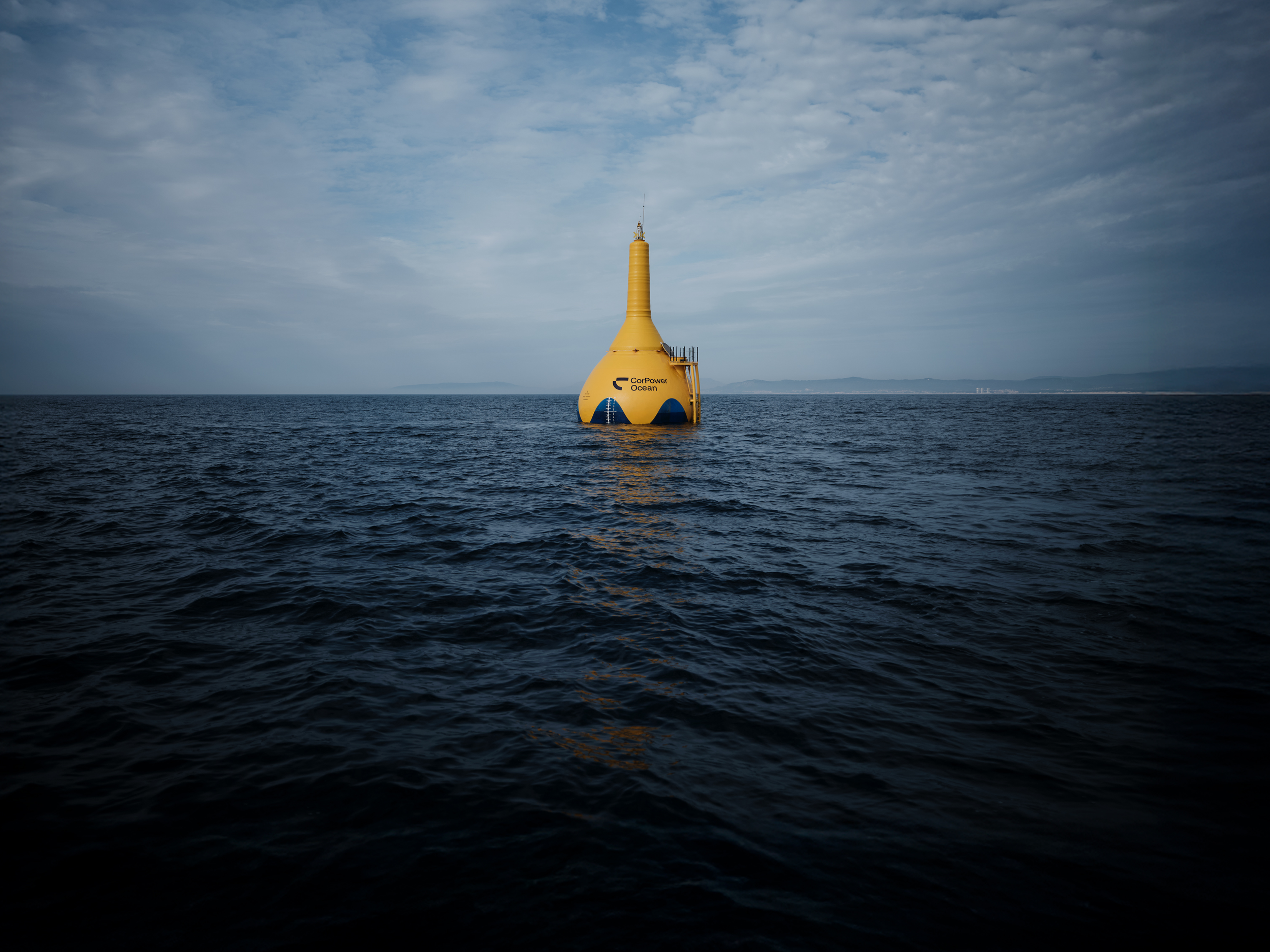
Led by CorPower Ocean, POWER-Farm EU will deliver the world’s first pre-commercial wave energy farm – a 2.5 MW installation of seven world-leading CorPower wave energy convertors (WECs), set to harness the powerful waves of the North Atlantic.
Building on the open-sea experience in Northern Portugal since 2023, this proven WEC technology will be deployed and demonstrated at the European Marine Energy Centre (EMEC), the world’s leading test site for wave energy. With established onshore and offshore grid infrastructure and pre-consented conditions, EMEC provides an ideal environment for large-scale deployment.
Over its 6-year lifetime and beyond, the project will demonstrate full farm-level systems, including control, electrical infrastructure, anchoring, and offshore operations. Bridging the gap towards large-scale manufacturing of wave energy devices, it will build the capacity needed to support hundreds of megawatts of future projects, while creating a strong pipeline to accelerate commercialisation and boost the European supply chain.
Our Objectives

Objective 1
Prove the survivability, reliability, and performance of a 2.5MW wave energy farm.
POWER-Farm EU is driven by a bold vision: to establish wave energy as a mainstream, reliable pillar of Europe’s renewable energy mix. By harnessing the vast, untapped power of ocean waves, the project aims to deliver up to 17% of electricity demand in targeted EU countries by 2050, supported by large-scale, EU-based manufacturing. In doing so, the project will strengthen Europe’s energy security, reinforce strategic autonomy, and accelerate the transition toward a fully decarbonised energy system.
To move towards this vision, the project focuses on demonstrating wave energy at scale. It will deploy and operate a 2.5 MW wave energy farm consisting of seven wave energy converters (WECs). The system is designed for long-term operation, with a target lifetime of 15 years, providing practical experience with performance, reliability, and maintenance in real conditions.
To achieve this, the project is structured around four specific objectives:

Objective 2
Prove a competitive EU supply chain ready to scale-up to larger farms.

Objective 3
Make wave farms competitive, bankable and insurable.

Objective 4
Demonstrate wave farm sustainability and low environmental impacts to key stakeholders.
How It Works:
The Heart of Wave Energy
Harnessing the Power of the Ocean: CorPower Ocean Wave Energy Technology
Discover how CorPower Ocean is tapping into the world’s largest source of unused clean energy: our oceans.
Inspired by the pumping principles of the human heart, our heaving buoys are designed for maximum efficiency and durability. Using advanced hydrodynamic research, the WEC features a lightweight design that thrives even in the most demanding marine environments.
How does the Wave Energy Converter (WEC) work?
CorPower’s WEC operates on principles inspired by the human heart’s pumping efficiency, using a pre-tension system that pulls the buoy downward while the wave’s upward force pushes it up. Stored pneumatic pressure provides restoring force that drives energy capture in both directions – creating a lightweight system that’s naturally “transparent” during storms unless actively controlled.
Unlike conventional systems where buoys passively follow wave motion, our advanced phase control technology precisely times oscillations with each wave, dramatically amplifying energy capture. This approach has been validated through extensive testing in both controlled environments and open ocean conditions, consistently demonstrating unmatched performance and reliability. CorPower’s technology delivers more than five times as much electricity per tonne of equipment, compared to the previous state-of-the-art in wave energy.
Learn more about the technology: https://corpowerocean.com/technology/
The Work Plan
-
WP1 focuses on the overall management and coordination of the POWER-Farm EU project. Key objectives are to facilitate collaboration between partners, monitor project progress, manage financial reporting, and address any potential risks.
-
WP2 focuses on the Front-End Engineering Design (FEED) phase, with the objective of advancing the project toward detailed design readiness. Key activities include completing all required survey work to support engineering studies, undertaking comprehensive front-end engineering and techno-economic assessments, and developing the environmental monitoring programme.
-
WP3 delivers the Detailed Design (DD) phase of the wave farm to support a go/no-go investment decision. Key activities include finalising the layout, subsystems, electrical infrastructure, installation and O&M procedures, and required permits to ensure readiness for deployment.
-
WP4 focuses on Procurement, Manufacturing, and Assembly, with the objective of delivering all CorPack systems and subsystems in accordance with the approved Detailed Design. Activities include the procurement and manufacturing of components, including hull fabrication, as well as the successful completion of Factory Acceptance Tests (FAT) to verify system performance and quality.
-
WP5 delivers on-land testing and de-risking of the CorPack subsystems before ocean deployment through dry-testing, system debugging, and performance validation. The work package also analyses and shares test results to support readiness for ocean testing.
-
WP6 covers the final assembly, testing, installation, and commissioning of the CorPack wave energy farm. Activities include pre-deployment checks, offshore installation of the WEC devices and infrastructure, and final validation to ensure the 2.5 MW wave farm is ready to operate and deliver electricity to the grid.
-
WP7, led by EMEC, focuses on the operation and independent validation of the wave energy array during ocean deployment. It covers long-term operation and maintenance, environmental monitoring and impact assessment, independent power performance assessment, and the collection of operational, performance and environmental data. Together, these activities provide robust evidence of performance, reliability and environmental compatibility to support the future commercialisation and scale‑up of wave energy.
-
WP8 addresses the pathway to commercialisation of the wave farm technology, focusing on sustainability assessment through assessment (LCA) and circular economy analysis, evaluation of supply chain capability and cost reduction potential, and development of a strategy for large-scale commercial deployment.
-
WP9 manages external communications for the POWER-Farm EU project to raise awareness of its objectives, results, and the benefits of wave energy. Key tasks include developing communication materials and the project website, running digital campaigns and events, and engaging with initiatives such as BRIDGE and AIOTI to share knowledge and best practices across the energy sector.